Building a new house last year, meant that I had the opportunity to purchase the latest and greatest cooktop and oven.
My new Kitchen
I was lucky that the builder had a 90 cm oven as standard equipment and I do love it. I do like to bake a lovely morning tea so the oven get used a lot.
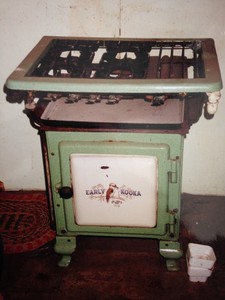
The cooktop in the house design, was gas as a standard addition, and I fondly remembered the teenage days of cooking on an ancient ‘Kooka’ gas stove, in my ‘haunted’ house – highly efficient and reliable. However….
Kooka Stove
I worked out pretty quickly that gas wasn’t great for someone living in the tropics. The phrase sweating away over a hot stove, was more real than I would care to admit, when I discovered the open flame of the gas cooktop, I was cooking with in my rental accommodation, caused the ambient temperature in the kitchen on a 36 degree celsius, overly humid, day to ignite to levels bordering on purgatory.
Thus, an upgrade to induction cooking seemed like a sensible move than a gas stove.
The new induction cooktop
The trouble is I had to purchase all new cookware as not all saucepans operate with the induction technology, which requires saucepans to be magnetic, to work.
I splurged a little and purchased two new non stick Induction friendly frypans, one a Raco and the second a Tefal Jamie Oliver style pan, as well as three beautiful induction freindly, non-stick saucepans, a lovely set made in France by Ingenio, with a detachable handle that could be used in the oven or cooktop, or served at the table.
So versatile, I thought.
Imagine my schock when I read that there was a problem with non-stick cookware.
A big problem….
Someone in the Estate by the Sea, where I live, had three parrots that lived inside their home. The owner was cleaning his self-cleaning oven, last week, which requires turning it to its maximum heat for an extended time in order to self clean the interior walls, of the oven.
Suddenly all three of his large parrots, including an African Grey parrot, (which can live to 200 years), developed breathing problems and died within 20 minutes of each other, ostensibly from the polytetrafluoroethylen fumes, emitted from the oven in its self-cleaning mode.
To back up his claim I did a little research:
…. the material used in most nonstick cookware, …the polytetrafluoroethylene (PTFE) coating on the pans turns into toxic Perfluorooctanoic acid (PFOA) at high heat, making it dangerous both for the cook and for diners.
It was in 2004 that the American Environmental Protection Agency (EPA) discovered the potential cancer-causing chemical used in the production of Teflon and filed complaints against the maker, DuPont.
At that time, a synthetic chemical called perfluorooctanoic acid, known as PFOA or C8 for short was used in the production of Teflon, however, it was phased out in the USA, in 2013 as PFAS chemicals, which includes PFOA and PFOS, had been linked to cancer and numerous other health concerns.
Despite DuPont completely eliminating the use of PFOA from use in their products, according to a spokesperson for the Australian Competition and Consumer Commission (ACCC), there is a wide range of products supplied in Australia that still include the related chemicals.
This week, I purchased a PFOA free frypan and worryingly note the Ingenio saucepans are now a discontinued product, in the larger retail stores. I shall have to ensure these saucepans are never used on high heat or should I ditch them and get stainless steel, all over again, for the Home by the Sea?
Do you use Non stick cookware, or use water resistant, stain resistant products?
There are more similarities between people from diverse cultures than there are differences. We can learn so much from each other if we keep an open mind.
Amanda Mac – Forestwood
Benefits of Writing a Blog
One of the best things about blogging is that it is not limited by geographical boundaries.
Unless you are new to The Home by the Sea , or my primary blog, S.t.P.A, you’ll more than likely know that I live down ‘under,’ at the ‘bottom end’ of the world. Down here in Australia, we can sometimes feel the tyranny of distance isolating us, from the rest of the world and a different time zone doesn’t help to foster good communications, at all.
Yet, the blogger community with its members spread across the globe, are a wonderfully diverse group. As an Australian blogging offers me the chance to expand my perspective, to hear and share different opinions and thoughts, that I’d otherwise not have been exposed to, and to feel the rest of the world is just that little bit closer, all without leaving my desk.
Yet it is still a virtual world, isn’t it?
Meeting other Bloggers
Exchanging Ideas with Ineke
Thus, when an opportunity arises to meet another blogger, I am pretty keen. Previously, I had met Inekewhen travelling in New Zealand, and both of us were surprised to find that, although we originated from different backgrounds, the connection we felt towards each other was surprisingly strong. A similar meeting with Lorelle, in Melbourne, confirmed blogger friends are often on a very similar wavelength.
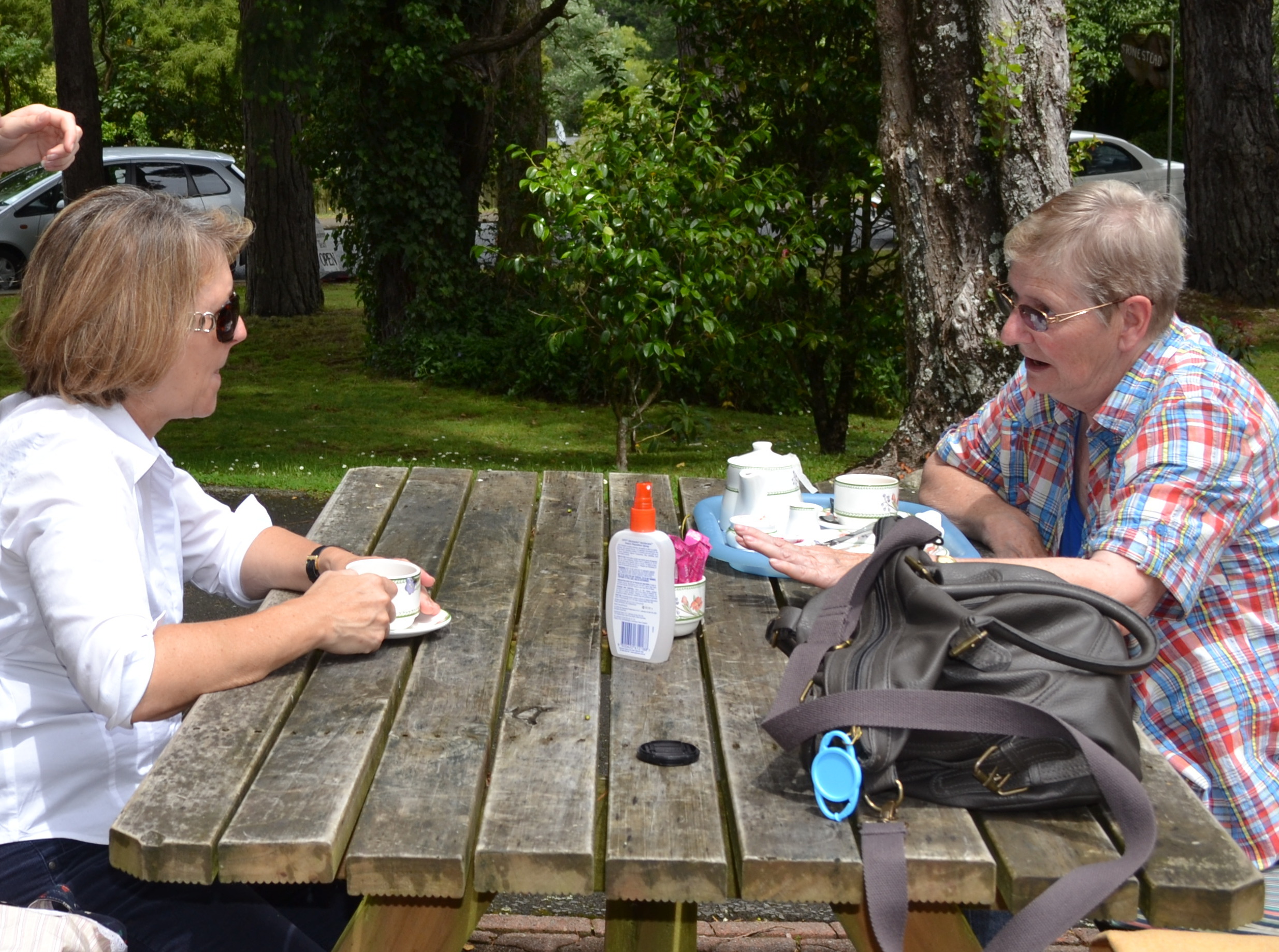
But did I know Catherine from Cyranny’s Cove, well enough for us to click? I knew little of her life in Canada, even though I had followed her blog for some time. Cyranny was coming all this way to Australia and visiting Brisbane, so I was super keen not to miss the opportunity to chat i.r.l. to another blogger and furthermore, to someone who loves Denmark, as much as I do. In fact, that is how I discovered Cyranny’s blog – browsing the wordpress reader for posts on Denmark, (as I sometimes do)!
Cyranny’s time here was short, and we were hampered in communications by Australia’s unfortunately medieval internet networks, so it wasn’t so easy to find time to meet. Especially since I have recently moved some 30 km away from the city, to the Home by the Sea, but eventually we settled on a time and date and met for breakfast in the city.
This year, Australia has experienced an extremely hot summer and with the fallout from the recent natural disasters of bushfire and floods, I was relieved to hear Cyranny and her partner tell me they had been lucky enough not to have their travel plans disrupted and had in fact, reached the chosen destinations without major hiccups, even experiencing some “up close and personal,” encounters with our unique wildlife that some Australians have not yet had for themselves. That was fun to hear.
Friends Across the Waves
Meeting Cyranny ended up feeling like I was having coffee with an old friend – the conversation was easy and comfortable and we settled down to enjoy breakfast, with the added bonus of a nice outlook over the Brisbane River.
Although our writing allows us to enjoy interacting with a completely different blogger set, we do share similar enjoyment in keeping our blog, and I found it so very interesting hearing her thoughts on Australia and the fun things they both had experienced, along the way.
Brisbane’s Sights and Attractions
As it is February in Brisbane, the year’s absolute worst month for heat and humidity, we then took a very warm, but pleasant walk along the riverside walkways and through the city’s Botanic gardens.
With the humidity rising rapidly, seeking out the shady colonnades of flowering Bougainvillea vines, at South Bank, seemed like a sensible idea.
I dutifully highlighted various points of interest, along the way: including the State Parliament building, a remnant of French Renaissance sophistication in the antipodes, the two Universities, the famous “City Beach”, and more importantly on a hot summer day, the New Zealand Ice Cream stand, with the totally awesome and weirdly named ‘Hokey Pokey,’ Ice Cream flavour. If you haven’t yet discovered Hokey Pokey, you are really missing something!
Hokey Pokey Ice Cream
Being the local, I also suggested they might like to consider a ride on the City Cats, (Public Catamarans Boats), that traverse the river that night, in order to visit Eat Street – an open air eatery upriver, at Hamilton. Eat Street comprises 180 or more stalls, all serving multi-national cuisine from modified ex-shipping containers. Along with music and twinkling lights, it is a unique experience for dinner on a hot summer night, in Brisbane and I thought might be fun for my Canadian friends.
They were also keen to visit the Lone Pine Koala Sanctuary – somewhat of a mandatory obligation when you visit Brisbane, as it is one of the few places operating since 1927, where tourists can get to hold a koala and hang out with the kangaroos and wallabies. I don’t want to divulge too much more about that, as Cyranny will no doubt tell you more when she arrives back home.
I was a little sad to wave goodbye so soon to Cyranny and her partner, but they had a date, to keep, with a koala. I wish them safe travels back to their home. I do hope they know they are welcome at our Home by the Sea.
Have you met any other blogging friends? How was your experience? Did you find many commonalities?
How much better is it to source organic citrus fruit straight from the garden?
Fruit that you can be sure is free from pesticides and sprays, because you have picked it directly from your own backyard?
If you have only experienced food purchased from the supermarket, you don’t know what you’re missing. Home grown fruit is so much juicier. This applies to most foods, freshly sourced.
It is not as hard as you think to grow your own food, even with limited space.
Benefits of Growing Your Own Fruit
save on packaging waste with supermarket products
better nutritional goodness
increased levels of juiciness and palatability
using your property to productive use
promoting food sources for bees
Unfortunately, those sad supermarket lemons sit in freight or storage for two weeks, before hitting the supermarket shelves, and then spend far more time in the supermarket, itself. Finally, someone purchases them, takes them home and pops them in their fridge, so they could be up to one month old or older, when they use them for meals. Eeew? Not really nutritionally sound.
I don’t have the space for a garden and my soil quality is poor, I hear many lament.
Citrus trees, such as lemons, can be successfully grown in pots, as long as they are positioned in a sun drenched spot, in the garden or courtyard and a good citrus fertiliser added in Autumn.
Meet ‘Lemon Heaven’ – a new seedless variety of lemon tree.
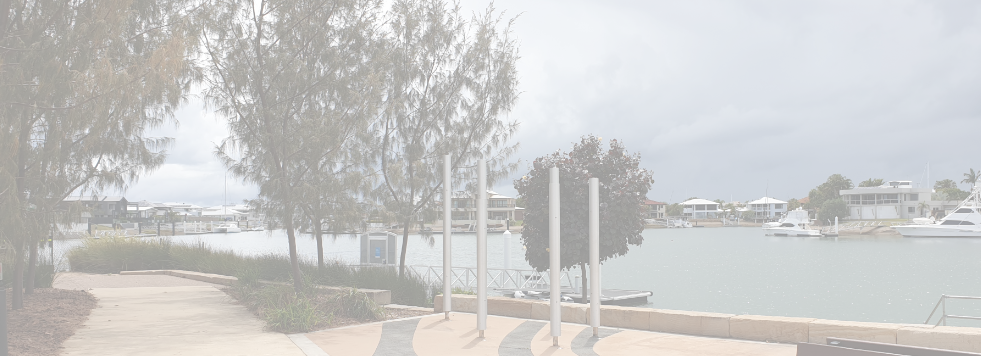
It is the latest addition to the Home by the Sea.
If you live in Australia, a dose of citrus food in small amounts monthly from August to mid autumn will help the little tree along. I also added some Seasol to the pot to help the new addition settle into family life at the Home by the Sea.
Getting up early to go walking in summer, brings you some delightful surprises. And let’s face it, it is SO much cooler when you live in the sub-tropics. It is also a time when the animals are more active, as they too struggle in the heat and like to rest when the sun is high.
Like this family herd of Kangaroos. You won’t see any around at noon, as they will be resting in the shadows, but go walking early morning and you will see them, enjoying the free grass shoots that emerged with the recent god given rains.
Perhaps you will join me on this walk as we take a glimpse into Australian fauna.
Photo Cred: Facebook
The gorgeous roos were making the most of the recent rains and although you cannot see them in the photo, One mum has a baby, called a joey, which we have often seen at the newly created and yet to be used, sporting fields at theend of a nearby road. The roos seem to be co-existing well with the encroaching development. Let us hope it stays that way.
“One man’s trash can be another’s treasure.”
The rain gives happiness to animals and people alike. For me, rainfall and cooler days are invigorating. After years of drought, and months of never ending bushfires, the rainfall last week of showers and the occasional thunderstorm is so glorious in all its wetness! Truly manner from heaven. The drought may not be over but the grass and plants respond.
I often think about that disconnect between feelings about rain. The folks in the Northern hemisphere have had enough of it and down here we crave it more and more. There never seems to be enough, for all of Australia, or if there is, it comes down in bucketloads, far too much for us and our fragile land to absorb.
Do you get how we feel about rain in Australia?
The ducks and swans frolick in the overflowing pond, and yes, our feet get muddy.
Yet it is this lifegiving substance the earth needs to rejuvenate, to heal, for water is the essence of life.
With blue sky as far as the eye could see in the other direction, I turned and headed back home. By the lakeside, I was greeted by the local birds. They were really happy too. Except perhaps, the baby galah!
He was probably pretty hungry by the sound of his raucous call.
Along with all the other walkers around the globe, Jo’s Monday walksinspire me to share a little of my home by the sea with others around the globe.
You know you are in Australia when you see a Koala in a tree! Australia’s unique marsupial is so specialized it only eats from around four species of Eucalypt trees. And it needs about 1 kilogram of them every day!
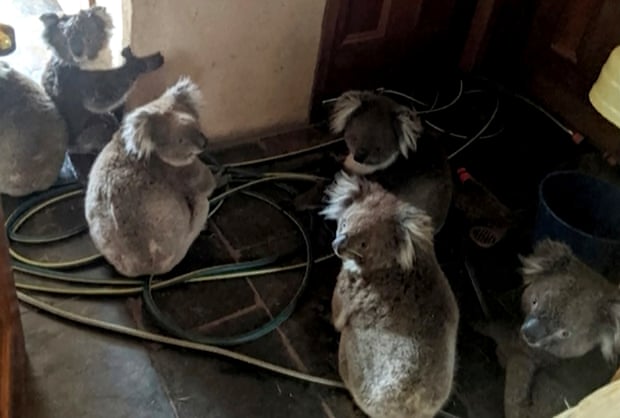
Koalas rescued during the South Australian bushfires Photograph: Adam Mudge/A
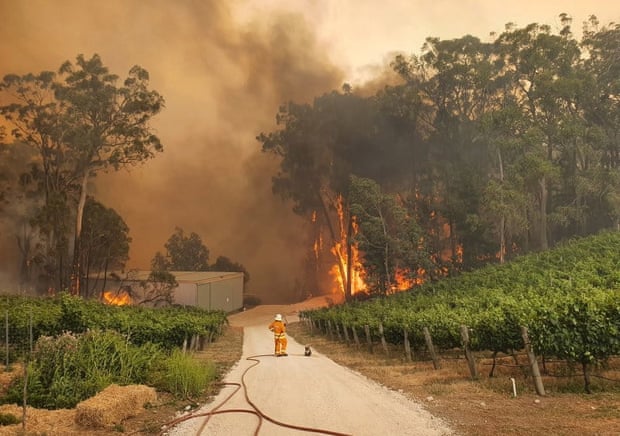
Koalas are super cute but they are endangered, and vulnerable to extinction and may potentially become extinct due to habitat loss, disease, limited interbreeding due to a declining population and more recently, significant bushfires in their natural habitat. At least 8000 koalas are thought to have died in the fires. We don’t know the real extent of loss.
Photograph: Eden Hills Country Fire Service/Facebook
We had koalas in our backyard trees, when I was a child, as we had tall Eucalypt trees. We had two males that were on the prowl looking for a mate, and were resting peacefully when the ranger came to collect them and take them back to the bush.
James Tremain, a spokesman for the NSW Nature Conservation Council, said in November that koala decline has been happening “slowly and silently.. and that Koala numbers have plunged over the past 20 years. According to the federal threatened species scientific committee koala numbers in two states have dropped 42% between 1990 and 2010.”
Guardian Australia
This is significant. How can a species, so specialized, stage a comeback when their food source, their only food source, is continually being cut down without replenishment? Residential areas that are cleared and developed, are not replanted with Eucalypt trees because they are too tall, continually drop branches and leaves and too large for back yards.
We have at least one resident koala in our estate – and we only have a few tall tress in the small Eco Zone between two large sporting fields and an estate of houses (without Eucalypt trees).So what will that wild koala go and what will they eat?
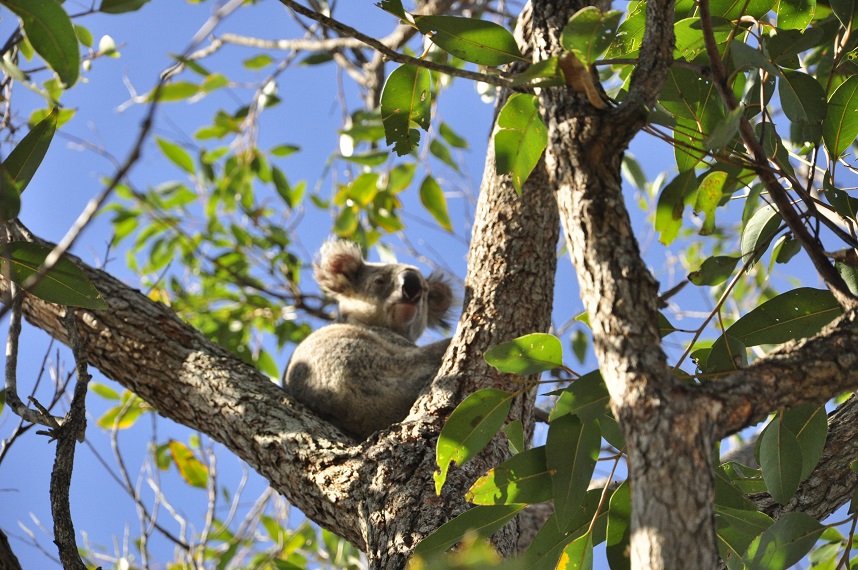
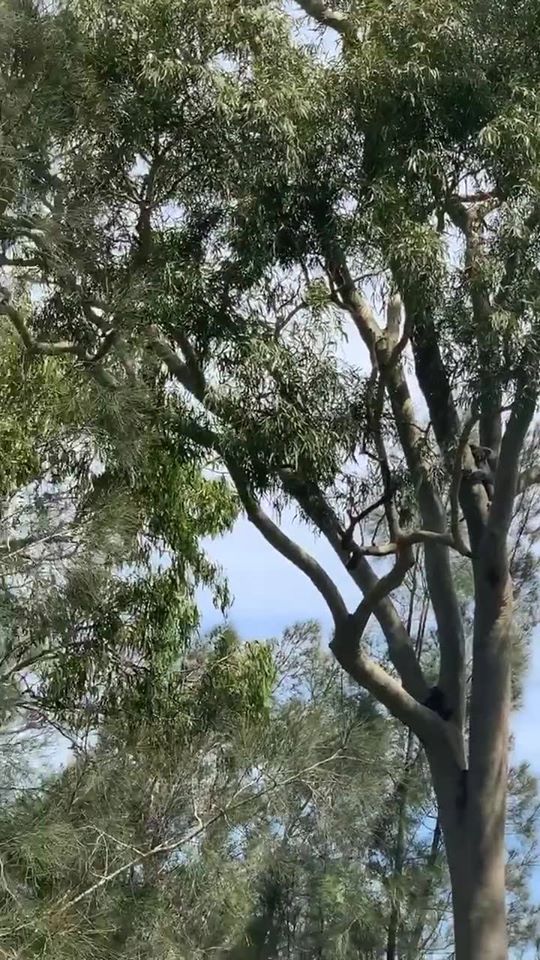
Can you see the koala?
Photograph – Facebook
Koala Facts
Koalas need oodles of sleep – around 18 hours. You would too, if you ate only one type of food all day, every day! That is why most of the time they are spotted in trees, they are sleeping.
You might be wondering how it survives on just gum leaves, as the oils in the leaves are quite poisonous. The Koalas have adapted to this specialized niche in the ecosystem, by having a very long digestive organ which allows them to break down the leaves and up til know were easily found throughout much of Eastern Australia. I spotted a few koalas on Stradbroke Island a few years ago.
The infant koala is called a Joey and it is pretty useless when it is born. Blind and earless when born the joey must use its strong sense of touch and smell, as well as natural instinct, to find its way into the pouch or face death. Being a marsupial it requires extended antenatal care that amounts to six to twelve months in its mother’s pouch, where it continues to grow and develop. After the first six months, the young koala will ride around on its Mother’s back until it reaches maturity.
I am kind of glad I am not a mumma koala!
Help for Koalas
Please support organizations that fund 24/7 care of wild koalas in trouble
Every day my daily walk takes me to the lake, usually with the resident Schnauzer in tow.
Who me? She says
It is a beautiful walk and the developer and Council maintain the street and pathways to a high standard. They want to sell the remaining blocks of vacant land, I guess.
What is very disappointing is that, each and every day, I find some plastic washed up by the shore of the lake.
Each day, I hope to find a clean and clear shoreline. Predominantly, I find plastic wrap for packs of single use plastic water bottles and plastic packets for food floating on the water or washed up on the rocks.
Each day, I remove this plastic and dispose of it in the rubbish bin; it’s just a few steps away.
In this small corner of the world, on just one corner of the lake’s shoreline, I am removing 2 – 10 pieces of plastic rubbish each and every day. So, let’s put that in a global context:
“Every year, about 8 million tons of plastic waste escapes into the oceans from coastal nations. That’s the equivalent of setting five garbage bags full of trash on every foot of coastline around the world.” (EACH YEAR!)
Plastic pollution has become one of the most pressing environmental issues, as rapidly increasing production of disposable plastic products overwhelms the world’s ability to deal with them.
Single-use plastics account for 40 percent of the plastic produced every year. Many of these products, such as plastic bags and food wrappers, have a lifespan of mere minutes to hours, yet they may persist in the environment for hundreds of years.
Some plastic contain additives to make them stronger and in doing so, extends their life meaning they will take up to 400 years to break down. At the rate plastic is being produced, we will be drowning in plastic, in 400 years.
Plastics – Key Facts
Half of all plastics ever manufactured have been made in the last 15 years.
Production increased exponentially, from 2.3 million tons in 1950 to 448 million tons by 2015. Production is expected to double by 2050.
Trash is also carried to sea by major rivers, which act as conveyor belts, picking up more and more trash as they move downstream. Once at sea, much of the plastic trash remains in coastal waters. But once caught up in ocean currents, it can be transported around the world.
Creates Pollution of waterways from chemicals entering ground water
Land Pollution from Landfill
Expels air pollitspollutathe manufacturing process
It Kills Animals – seabirds and fish get caught inside or around it
It is Poisonous – to humans and animals
It is Expensive – it costs more to produce than a reusable natural bag
I will be keeping a count of the days without plastic.
How You Can Help
Responsibly dispose of plastic pollution when you find it in your local area
Say No to Plastic bags from shops
Use re-useable cloth or string bags
Refuse products with excess packaging
Ask if the packaging is reuseable PRIOR to purchase- especially with take away food, smoothies, coffees and drinks, so that business owners try to be more selective in their product choice
Carry a refillable drink or coffee flask and reusable straws
Don’t buy bottled water – or drinks in plastic bottles – preference glass containers where possible
Be responsible with your own rubbish when out and about
In Japan, I never saw a single item of rubbish in the streets. The Japanese are very conscious of taking their own rubbish away with them.
If the Japanese can do it with their mega population, we can do it too.
Let’s change the culture of plastic reliance everywhere!
Would you like to come for a walk along the beach with my dog and me?
I like to be up early in the morning. It is a magic time down on the beach. This is the entry to the beach at Redcliffe, Australia.
As you might have suspected, it is called Redcliffe for the red colour of its cliffs. Unfortunately, they are not really visible at this point and we’re walking in the other direction today.
Let’s go!
Are you okay to negotiate the stairs?
This part of the beach is popular with shore fisherman. The gentlemen on the right had just caught a stingray after the photo was taken. He then cut off the hook and kicked the stingray back into the water with his bare foot. The ray seemed fine with its ordeal, as it swam enthusiastically away. I suppose its take away from the experience was a small breakfast of fisherman’s bait.
Some of the houses, fronting the shore, have magnificent views towards the ocean, although some are showing their age. They may be weathered and beaten by the elements but are still standing strong, much like most of the trees.
Until that is, the Council might decide the tree must be cut down.
I am unsure of the reason for the lopping of this tree as it was massive. I recall it being a Moreton Bay Fig, which blogger Margaret mentioned just the other day. One major concern is the stability of the bank, once the roots are removed.
I love that some of the staircases are equipped for bicycles, or kayaks on wheels. Not that I would be riding down there. It looks far too steep for my skills.
A man and his Schnauzer
I continued on for another 500 metres or so.
The recent summer storms have taken a toll on this old cottonwood tree. I think the Council will try to salvage this one.
The walk along the beachfront here is special becuase there’s a fantastic feature tree further along that forms a Tree Tunnel. This is the first time I have ever seen a warning sign saying: Beware – Low Tree Branches.
Watch your head as you walk underneath.
It is low.
I had to bend my head down and my husband says I am part ‘Hobbit’.
At this point, we decided to turn back to our starting destination exiting back through the tree ‘cave.’
The perfect frame for the distant container ship on the horizon. The water between Redcliffe and Moreton Island forms a major shipping lane to the port of Brisbane.
We took a detour on the way back inorder to check out a nice cafe we spotted on the way up. After all, isn’t it a tradition of Jo’s Walks that the walk ends with cake?
Captain Cook and Whitby Abbey
History buffs might want to pay attention to this part of the walk. The smaller rock to the left is a piece of the ruins of the Abbey at Whitby, England. Whitby was the home of Captain James Cook, the first Englishman to chart the East Coast of Australia. The larger rock commemorates Captain Cook’s Journey past this point, way back, in 1770.
From this point, maintaining a southerly direction will find you at a Sunday Market adjacent to a long cafe and shopping street complete with modern pier and jetty, where you will find many more fisherman.
Here is what it looked like in years gone by:
Redcliffe History
The town’s name originates from “Red Cliff Point” named by the explorer Matthew Flinders, referring to the red cliffs at Woody Point.Redcliffe was originally the site of the first penal colony in Queensland. It was discarded when the colony moved further inland and slowly it evolved as a small seaside retreat north of Brisbane until the construction of the Hornibrook bridge which linked Brighton, an outer Brisbane suburb, to the Redcliffe peninsula.
Our little estate by the sea is set to grow and thrive. The developers have not just built houses. They want to build a community.
The development will also include a shopping and dining precinct.
I am looking forward to it. No fixed date yet, but it will include cafes, a fresh food and small market and a ancillary health suites. Good for those wanting to retire by the sea.
Some people are concerned about the high density that more development may bring. To me, it is part of living in an attractive part of the world. Near services, close to a major capital hub, or at least within commuting distance, and a waterfront lifestyle.
For many that is paradise. And of course, it represents profits for the developer, who commenced the original part of this peninsular development about fifty years ago.
Any development always represents a tussle between losing the natural environment and the needs of a growing population, and an economy that pushes and supports progress and profits. How to balance the two?
Not easy.
There is a community group that is opposing the increase in height from 5 stories to 7 stories for mid to high density townhomes and apartments.
Am I concerned? Normally I would be, and if it was right on my doorstep, yes I would absolutely be against it? But really they are arguing about air space. The air between five and seven stories!
You must be logged in to post a comment.